
The European PYRMOVE project aims to develop and implement cross-border tools for forecasting and managing the risk of landslides.
18 July 2023

PYRMOVE - Landslides in the Pyrenees

The European PYRMOVE project aims to develop and implement cross-border tools for forecasting and managing the risk of landslides in the Pyrenees.

© BRGM

Starting in 2016, local stakeholders on the French and Spanish sides came together to create a project examining land movement in the Pyrenees. That issue hadn't previously been analyzed or tackled. Together we built a program known as the PyrMove project to examine land movement triggers in the event of heavy rainfall and to study major landslides that can impact infrastructure. The problem of landslides here in Val d'Aran is a big one that occurs regularly. So studying and creating an early warning system is vital for public safety. The idea was to promote studying the risk related to land movements as a specific risk. It is very prevalent in the Pyrenees. The risk is often studied and is often associated with rainfall. One aim of this project was to look at this risk as separate from flood risks, for example. The project's second objective was to study a range of sites to assess the risk and come up with ways to reduce it. The Catalonia Institute of Cartography and Geology became involved in communications and other work on the project, but on a technical level. We focused mostly on characterizing regional landslides and other land movement episodes. These landslides affect roads, hindering the passage of emergency and evacuation services. So it's important to know when they will occur and ensure that emergency and first aid services will know what to expect and be able to get to where they need to be. For an overall understanding of how landslides develop and the shifts involved, we need to monitor deformation and displacement along with water levels, which are always the driving force behind these movements, so we can determine the thresholds that correspond to sudden accelerations and will allow us to make decisions about how best to protect the population. Of the three sites, two are in France. First is Viella, where a village is located, a site that is studied by a group of experts for the French government. There are several studies. One is an assessment on behalf of the Prefect to inform him about the development and evolution of land movements, which was prompted by the major flooding in June 2013 in Bastan. Alongside that is more scientific work: instrumentation, setting up inclinometer sensors and piezometers, and time-tracking movements. That is the subject of research in association with BRGM and the ONF's RTM services. The second site is Gourette, which was chosen because of the associated risks, particularly the presence of a ski resort and a main road. We set up a dozen GPS terminals. We also drilled five wells to monitor groundwater levels and a rain gauge to track precipitation. The purpose of this instrumentation is to obtain long-term data so we can track landslide activity. The minimum period is five years. The third site is in Andorra: the Canillo site. It's known as one of the biggest landslide sites in the Pyrenees, threatening a water inlet channel at the power plant supplying Andorra. We take part in all the actions, except the last one, MORLEs. We collaborate by contributing local knowledge of the region. For example, as we are one of the study areas of the Canillo movements in Andorra, all the knowledge generated by the project is valuable both for civil protection and geological knowledge of the movements. Another aspect of the project is cross-border cooperation. We are a small country, so working with neighbors who face the same problems means more information and knowledge transfer. Today, at the invitation of the Val d'Aran community, we presented educational tools, or software and software packages so a municipality can show its citizens and various managers how these phenomena occur and what triggers an earthquake, water, floods, etc., and see the broad connection between disaster events in the high valleys. Using the tools developed for this project, we now have landslide susceptibility maps, which indicate areas of the region that are susceptible to landslides as well as a simulator for MORLEs, or massive events. In today's workshop, we showed administrators and technicians how to use these tools. As well as in-person groups, we had online participation with simultaneous interpretation from Spanish to French. During the project, one of the partnership's commitments was to publish details and raise public awareness of the dangers posed by major land movements. To reinforce this idea, we decided to create a monograph, or a book, which is one of the results of the project. We hope it becomes bedside reading for authorities and those working on land management. All the studies carried out as part of the PyrMove project and the techniques developed are rapidly applicable. The important thing now is to find financing so that the theoretical and practical knowledge gained can be directly applied to prevention management. The project was a success in terms of methodology development and tool transfer to communities. We hope it carries on in the context of future calls for projects in order to pursue this issue in the Pyrenees. 

Landslide management is a major issue for the safety of people and property in the Pyrenees and for the economic stability of the municipalities in the area. Over the past 80 years, at least 150 people have died from landslides and the economic damage has exceeded 300 million euros.

Improving landslide emergency management

The aim of the PYRMOVE project, coordinated by the Polytechnic University of Barcelona (UPC) and, in France, involving BRGM and CEREMA (as well as RTM, the University of Pau and the Civil Protection Association as associated partners) is to develop and implement cross-border tools for forecasting and managing the risk of landslides.

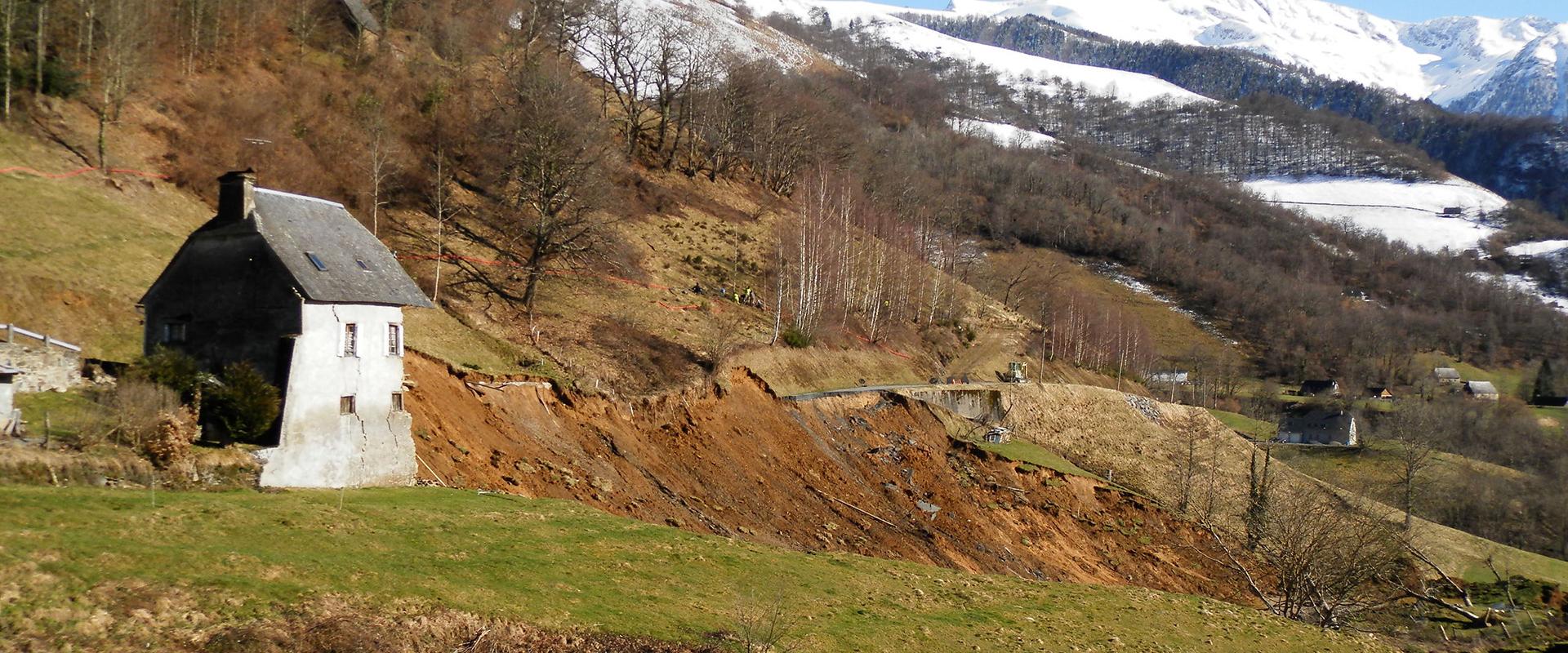
These tools are developed to promote efficient emergency management, as for example in 2018 when a mudslide obstructed the access road to the Monts d'Olmes ski resort, trapping 2000 people and shutting down the resort, or such as the blocking of the Gourette departmental road also in 2018, or again in 2015 with the Gazost landslide that isolated a hamlet.

The tools will be used in several areas of the Pyrenees, both on the sub-regional and the local scale. They will guide optimised and harmonised management strategies that can be replicated on the scale of the Pyrenees.

This project will provide knowledge and will involve experiments on the landslides at Gourette, which damaged the departmental road and cut off access to the resort, and at Viella, which still threaten an entire village.

Action taken under the programme is divided into 3 areas:

  • understanding the hazards;
  • emergency management assistance;
  • information and communication.

The study area covers the entire Pyrenean mountain range. For France, the Occitanie and Nouvelle-Aquitaine regions are involved.

Role of BRGM

BRGM will contribute to the following main actions:

  • Summarising past events and conducting a retro-analysis of the conditions that triggered the landslides;
  • Examining the risks involved in 2 of the 3 major landslides studied: Gourette (Pyrénées-Atlantiques) and Viella (Hautes-Pyrénées), including a field assignment, satellite image processing and the use of instruments;
  • Proposing solutions to reduce risks through the development of monitoring and warning systems to promote preventive action with regard to the phenomena under consideration.

Funding and partners

Interreg POCTEFA logo, PYRMOVE project

Interreg POCTEFA logo, PYRMOVE project.

© POCTEFA Interreg

This project was successfully selected in the last POCTEFA 2014-2020 call for projects for objective 5, focus area 2. The project is scheduled to run from 1 January 2020 to 31 May 2022. The total budget for the project with the partners is €2,010,576 for the eligible part.

The partners in this project are:

The Massif des Pyrénées police department is a financial partner of the project.

Link with the ADAPYR project

The PYRMOVE project deals with the operational aspects of emergency management in the event of incidents and access closures. The ADAPYR project handles the medium and long-term planning aspects with regard to global changes (climate, hazards, vulnerabilities, changes in demand in the tourist industry, etc.) in a context of uncertainty about the change variables being dealt with.