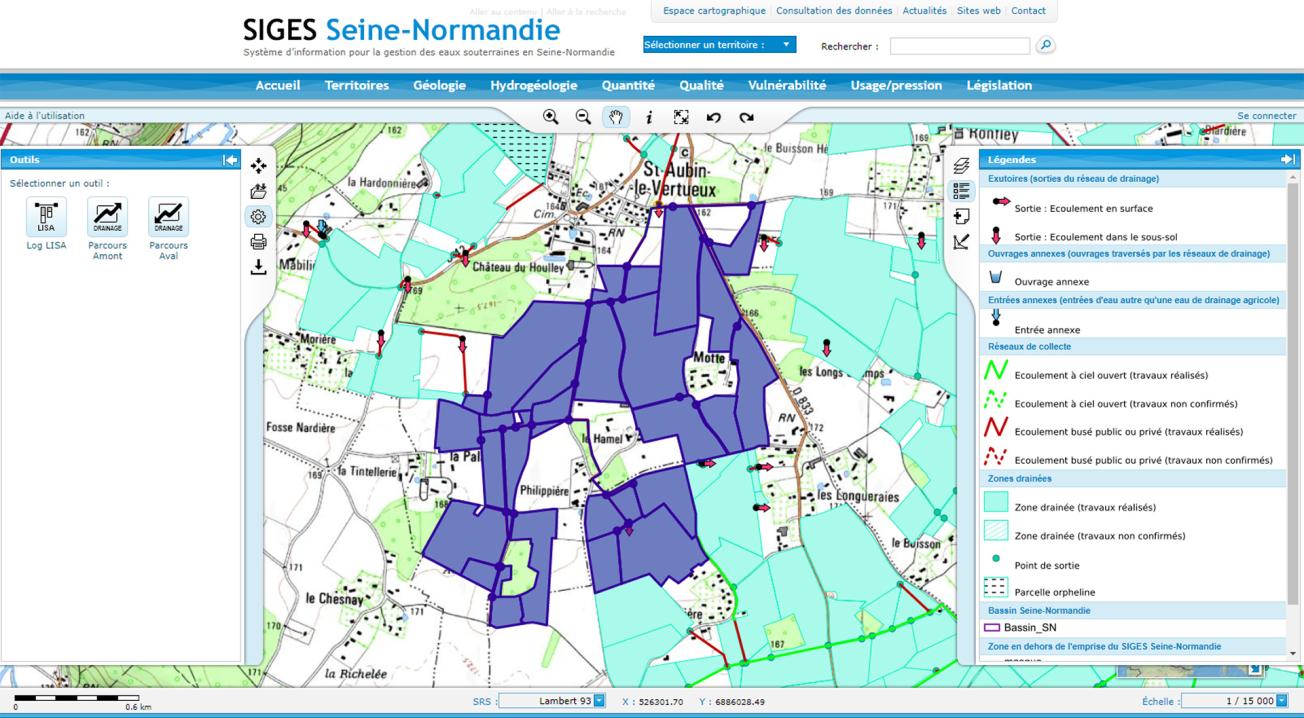
Dissemination and consultation of the Drainage Database on the Seine-Normandy SIGES: example of a map showing the upstream routes of the drained water flow.
© BRGM
The need
In the second half of the 20th century, in order to boost agricultural yields, local and regional authorities and the State generously subsidised drainage constructions, which can have both qualitative and quantitative impacts on surface water and groundwater. However, data related to agricultural drainage are now jeopardised (lost or damaged archives, uncertainty about locations, etc.). It is therefore necessary to preserve this knowledge by giving it a new lease of life in digital form, which would also make it easier to exploit through the use of information technologies.
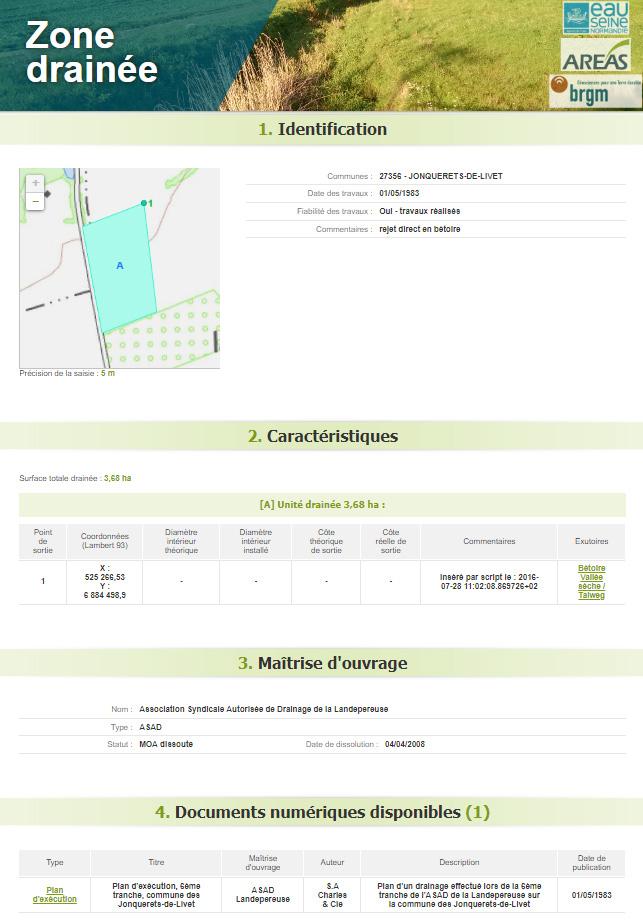
Consultation sheet for a drained area.
© BRGM
The results
In the first phase of the project, the archives for the Eure and Seine-Maritime départements were identified and a model was developed to exploit the digitised data. The second phase, which began in 2016, focused on implementation. The system (from data entry to information dissemination) set up under this project is as follows:
- Data entry website
- Data storage in a PostgreSQL database hosted at BRGM,
- Data dissemination website, in the Agricultural Drainage section.
The consultation and data entry websites were launched in 2017. In order to add value to the data, innovative features have also been developed. For example, by creating connections between specialist applications, it is possible to determine the direction of flow of drained water from agricultural plots to the points where they are discharged into the natural environment.
Using the results
Since February 2017, the SIGES Seine-Normandie has made online consultation available to everyone. Map layers, services showing upstream and downstream paths and more detailed technical data sheets all enable the public to access the knowledge contained in the database and to exploit its different characteristics. The enrichment of the drainage database with related services makes it a real decision-making tool in terms of water and risk management and resource protection for local authorities and engineering design firms.
The partners
- Seine Normandy Water Agency
- AREAS
- Eure Departmental Council
- Seine-Maritime Departmental Council
Our partnership with BRGM enabled us to create a database in which we have compiled the data archived since the 1970s. We make them available to water managers who can themselves add to them with their own research results on drainage. This tool is of use to local and regional authorities for water conservation, risk management and also for knowledge of the agricultural landscape.